



Winning an office cleaning contract is not just about offering the lowest price. A quotation that is too cheap can leave you operating at a loss, while one that is too expensive may lose you the opportunity. The key is to prepare a professional quotation that covers your costs, remains competitive, and demonstrates value to the client.
Whether you’re a startup cleaning company or an established business looking to grow, understanding how to price your services correctly is essential.
1. Start with a Site Inspection
Avoid quoting without first visiting the client’s premises. Every office has different cleaning requirements, and a site inspection helps you estimate the time, labour, and materials needed.
During your visit, take note of:
- Total floor area (square metres)
- Number of offices
- Boardrooms and meeting rooms
- Reception area
- Kitchens and canteens
- Toilets and ablution facilities
- Staircases and passages
- Carpeted and tiled areas
- Internal and external windows
- Number of employees using the building
- Parking areas or outdoor spaces (if included)
Also confirm how often the premises need to be cleaned – daily, three times a week, weekly, or monthly.
2. Calculate Your Labour Costs
Labour is the largest expense in most cleaning contracts, often accounting for between 60% and 75% of the total contract value.
When calculating labour, don’t only consider employees’ salaries. Include additional employment costs such as:
- UIF contributions
- COIDA
- Paid leave
- Public holidays
- Overtime (where applicable)
- Relief staff to cover absences
Underestimating labour costs is one of the biggest reasons cleaning businesses struggle to remain profitable.
3. Include Cleaning Materials and Consumables
Your quotation should clearly indicate whether you will supply cleaning materials and consumables or whether the client will provide them.
Typical cleaning materials include:
- Multipurpose cleaners
- Toilet cleaners
- Glass cleaners
- Degreasers
- Bin liners
- Mop heads
- Microfibre cloths
- Gloves
- Floor polish
Consumables may include:
- Toilet paper
- Hand soap
- Paper towels
- Air fresheners
Always clarify what is included to avoid disputes later.
4. Don’t Forget Equipment Costs
Cleaning equipment represents a significant investment and should form part of your pricing.
Examples include:
- Vacuum cleaners
- Floor scrubbers
- Buffing machines
- Pressure washers
- Cleaning trolleys
- Extension leads and accessories
Even if you already own the equipment, include a monthly recovery cost to cover maintenance, repairs, and future replacement.
5. Factor in Transport and Administration
Many new businesses overlook operational expenses.
These may include:
- Fuel
- Vehicle maintenance
- Travel time
- Office expenses
- Internet and telephone
- Accounting services
- Insurance
- Staff uniforms
- Personal Protective Equipment (PPE)
Ignoring these costs can significantly reduce your profit margin.
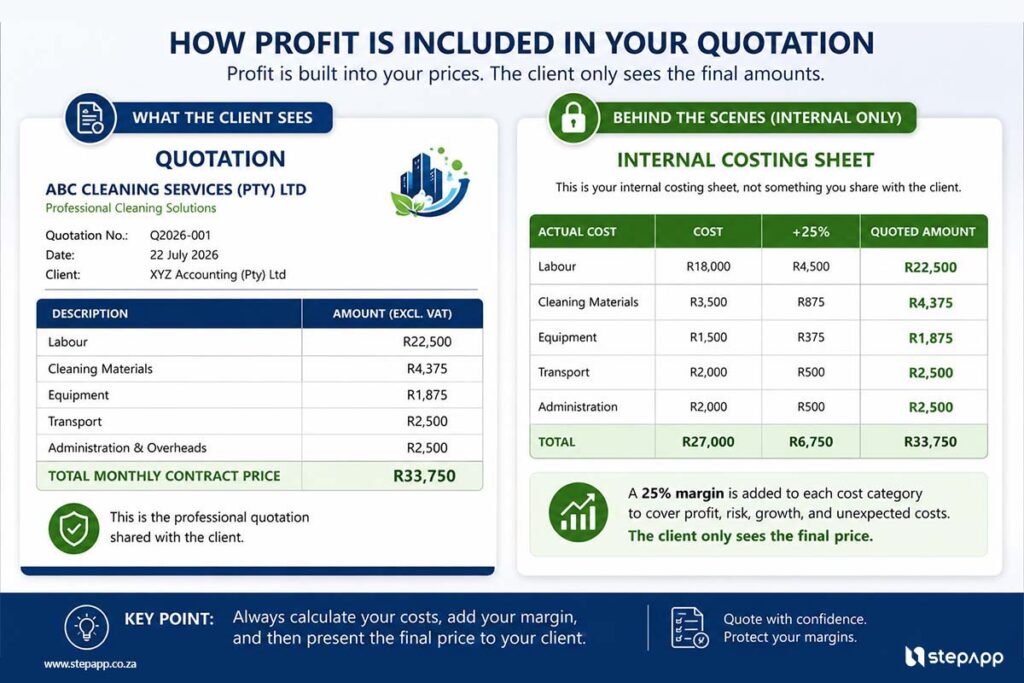
6. Add a Reasonable Profit Margin
Once you’ve calculated all your costs, add a profit margin that reflects the level of competition and the complexity of the work.
As a general guide:
- 15–20% – Highly competitive tenders
- 20–30% – Private companies and commercial offices
- 30% or more – Specialist or high-risk cleaning services
Remember, profit is not what’s left over after expenses – it should be built into your pricing from the start.
StepApp Tip: Prepare two documents for every contract. The first is an internal costing sheet, which calculates your actual costs and desired profit margin. The second is the client quotation, which only displays the final prices for each service or cost category. This approach protects your pricing strategy while presenting a professional quotation.
Step 7: Compare Your Price with Market Rates
Once you’ve calculated your labour, materials, equipment, transport, overheads, and profit, it’s a good idea to compare your quotation with typical market rates. Many clients, especially those requesting multiple quotations, use cost per square metre as a benchmark when evaluating cleaning companies.
Although you should never rely solely on square metre pricing, it provides a useful starting point for businesses that are new to the industry.
The table below shows typical monthly rates for office cleaning contracts in South Africa.
| Cleaning Frequency | Typical Market Rate |
|---|---|
| Daily office cleaning | R18 – R35 per m² per month |
| Three times a week | R12 – R22 per m² per month |
| Weekly office cleaning | R4 – R10 per m² per month |
For example, if you’re quoting to clean a 500 m² office every weekday and you decide to charge R25 per m² per month, your monthly quotation would be:
500 m² × R25 = R12,500 per month (excluding VAT).
Keep in mind that these rates are only guidelines. The actual price will depend on several factors, including:
- The number of employees occupying the building.
- The number of kitchens and toilets.
- Whether the floors are carpeted, tiled, or a combination of both.
- The amount of internal and external glass that requires cleaning.
- Whether cleaning takes place during office hours or after hours.
- Whether consumables such as toilet paper, hand soap, paper towels, and bin liners are included.
- Any specialised services such as carpet shampooing, floor polishing, high-level cleaning, or exterior window cleaning.
Two office buildings with the same floor area can have very different cleaning requirements. For example, a busy call centre with 200 employees will generally require more labour, cleaning materials, and consumables than a professional services office of the same size with only 40 employees.
Use these market rates as a reality check rather than your primary pricing method. The most successful cleaning businesses calculate their costs first, add a reasonable profit margin, and then compare the final price against market benchmarks to ensure it remains both competitive and profitable.
What Should Your Quotation Include?
A professional quotation should clearly state:
- Scope of work
- Cleaning frequency
- Services included
- Number of cleaners assigned
- Equipment provided
- Materials included or excluded
- Contract duration
- Payment terms
- VAT status
- Quotation validity period
Providing a detailed quotation builds confidence and reduces misunderstandings once the contract begins.
Tips for Winning More Cleaning Contracts
Besides competitive pricing, clients look for professionalism and reliability. To improve your chances of winning contracts:
- Register your business with the CIPC.
- Keep your tax affairs up to date with SARS.
- Register on the Central Supplier Database (CSD) if you intend bidding for government work.
- Obtain COIDA registration if you employ staff.
- Invest in staff training and proper uniforms.
- Prepare a professional company profile and capability statement.
- Request testimonials from satisfied clients.
- Respond to enquiries quickly and professionally.
Related opportunity: OBP Seeks Cleaning Services Provider for 12-Month Contract
Quote Smarter, Grow Faster
Pricing an office cleaning contract is about more than estimating how long it will take to clean a building. A successful quotation should account for labour, materials, equipment, transport, administration, and profit while remaining competitive in the market.
Before submitting any quotation, take the time to inspect the site, calculate your costs carefully, and present your pricing professionally. A well-prepared quotation not only increases your chances of winning the contract but also ensures your business remains profitable in the long term.
Need help growing your business? Visit StepApp for the latest business opportunities, tenders, funding, training programmes, and practical resources designed to help South African entrepreneurs build sustainable businesses.
Stay Updated
Want to stay informed about more tenders, funding opportunities, and business tips? Follow our updates on the StepApp Network:
- WhatsApp Channel: Follow StepApp Updates
- Facebook Page: Follow us
- WhatsApp Group: Join here
- LinkedIn Profile: Connect with StepApp
- X (Twitter): Follow StepApp SA on X